How Venice’s Ridotto Made Casino Gaming a Public Spectacle
See how Venice’s Ridotto joined gaming with social display, and learn to distinguish a venue’s history from the image created by travel writing and fiction.
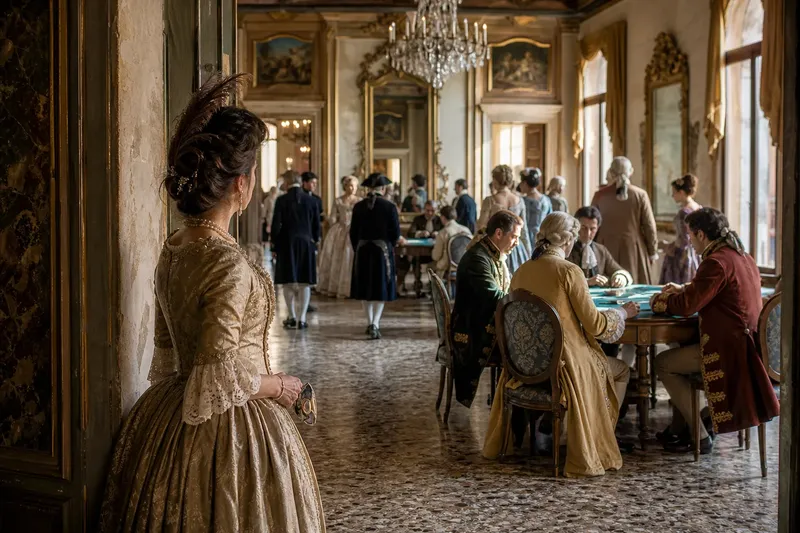
In a Venetian palazzo, a visitor pauses at a gaming room’s threshold while other guests move between tables and adjoining rooms. The Ridotto gives a concrete way to ask how casino gaming became a public spectacle: not simply through play, but through the visibility of players, visitors and their conduct.
The shift was neither sudden nor universal. Private card rooms and public gaming venues coexisted, and a single Venetian example cannot establish how every casino developed. It can, however, show how a setting for play could also become a setting for social display.
The Ridotto joined gaming with public display
Venice’s Ridotto is commonly associated with the Palazzo Dandolo and the eighteenth century. Histories describe it as a regulated public gaming house operating during carnival. Those details should be checked against reliable historical sources before being used to make a precise claim about its opening, rules or schedule; the broad point here is the venue’s place in accounts of public gaming.
“Public” does not mean that everyone had equal access. Regulations, dress expectations and social conventions could shape who entered and how they behaved. A public venue differed from a private household, but that distinction does not by itself tell us who was admitted or what each visitor did.
Gaming rooms could make play visible to others in the venue. Arrivals, movement between rooms and conduct around a table might form part of the social scene. This is a way to interpret the setting, not proof that every visitor wanted attention or that all casinos were arranged alike.
Room layout shaped what visitors could see
A private parlour and a public gaming house organise company differently. In a parlour, a host controls admission and guests may already know one another. A public venue can gather a less familiar crowd, while still maintaining its own rules and social boundaries.
Tables focus attention on play. Doorways and routes between rooms can make arrivals and encounters noticeable. Architectural plans or descriptions may help explain how a room was organised, but they cannot alone establish who attended or how people experienced it.
What is not worth the effort is inferring a venue’s full social history from a grand façade or a dramatic picture. Such images can suggest how a building was represented, but claims about its use need evidence such as rules, records or contemporary descriptions.
Travel writing and fiction framed the casino
Travel accounts present places through a writer’s route and viewpoint. Fiction can turn a gaming room into a stage for a story about money, manners or status. Neither form is a neutral record: each can reveal how a venue was imagined, while leaving open how typical that image was.
Say you are examining an invented travel passage that names the Ridotto but gives no date. First, record the named venue and mark the date as unknown. Next, separate the passage’s description of tables and room movement from its judgement that the scene seems glamorous. Then compare those claims with a dated venue record, if one is available. If the record confirms the place and activity, you can support those limited details; if it does not, treat the passage as evidence of the writer’s portrayal, not as proof of the venue’s ordinary operation.
When reading an account, note whether it names a place, supplies a date or occasion, and distinguishes observation from opinion. A vivid scene may help explain the casino’s cultural image without establishing how common that scene was.
Private gaming continued beside public venues
Accounts of elite life also describe card games in private rooms, where invitations and personal ties shaped the gathering. Such rooms produced a different social scene: a host decided who belonged, and a player’s behaviour mattered within a more familiar circle.
That image of private play existed alongside accounts of public venues. The contrast is not simply old against new. A private room makes admission to a circle central; a public gaming house makes a broader gathering more visible, even if access remains restricted.
Stories may favour one setting because it suits their purpose. A small room can focus attention on secrecy or rivalry, while a public hall can bring arrivals and observation to the foreground. Those choices tell us about the story as well as the history it evokes.
What can evidence establish about casino spectacle?
What was the Venetian Ridotto?
It is remembered as a public gaming house associated with Venice’s Palazzo Dandolo and carnival-season play. For precise dates, regulations or operating arrangements, consult a reliable historical source rather than treating a brief description as sufficient evidence.
Did a public gaming house admit everyone?
No conclusion of universal access follows from the word “public”. Rules and social conventions could limit entry or shape participation, so claims about particular visitors need evidence of their own.
What can a building reveal about gaming?
Rooms and routes can help explain where play occurred and what might have been visible to other people. To identify actual users or practices, compare architectural evidence with records and contemporary descriptions.
How should a travel account be used?
Record the named place, any date or occasion, and the writer’s viewpoint. Treat descriptions of mood and glamour as the author’s portrayal unless separate evidence supports a broader historical claim.
Keep the venue and its image distinct
- Observation: A source names the Ridotto. If it also identifies a reliable record, use the name for that documented venue; otherwise, describe it as the writer’s identification and seek corroboration.
- Observation: A passage gives a date or occasion. If the date can be checked against another source, use it with appropriate attribution; otherwise, mark it as the writer’s claim.
- Observation: A rule or regulation is quoted. If its provenance and date are clear, use it for the period it covers; otherwise, do not generalise it to other years or venues.
- Observation: A plan shows rooms or doorways. If the plan’s date and connection to the venue are established, use it to discuss layout; otherwise, treat it as an uncertain representation.
- Observation: A traveller describes a crowded or glamorous scene. If independent records support the detail, present it cautiously; otherwise, use it as evidence of the traveller’s impression.
- Observation: A fictional scene depicts private play. If the work is being analysed as fiction, discuss its themes; otherwise, do not cite it as a record of actual attendance or conduct.
Venice’s Ridotto helps explain how casino gaming could become a public spectacle, but it cannot mark a universal turning point on its own. The useful distinction is between what a venue’s records can establish and what travel writing or fiction invites its audience to imagine.
For a careful account of how the casino became a place to be seen, connect each claim to a particular building, rule or text. That habit preserves the value of the Ridotto as an example while leaving room for the varied histories that one famous venue cannot represent.